Where is your hiring losing talent?
7 questions, 2 minutes, 3 action priorities.

A consulting firm can hire its experienced consultants and managers directly, on three conditions: talk about assignments and career path rather than values, reach consultants while they are on assignment, and run a short process led by the partners. Headhunters keep their place for partners and very rare profiles, not for the core of your hiring.
When should you hire a consultant directly rather than through a headhunter?
Executive search brings a network and search time. It also comes with a high cost per hire, and it leaves the firm’s message in other hands. For most experienced consultant roles, direct hiring is more cost-effective, provided it is organised.
| Situation | Direct hiring | Executive search firm |
|---|---|---|
| Experienced consultants, several roles a year | Suitable: reusable pool, controlled cost | Expensive at constant volume |
| Manager or senior manager | Suitable if the partner leads the process | Useful if the market is very tight |
| Partner, niche expertise | Possible but slow | Often relevant |
| Confidential hire | Difficult | Relevant |
To compare on real figures, our guide to the cost of a hire in France details the cost items to include, fees included.
What makes a consultant on assignment move?
An experienced consultant does not change firms for an employer brand. They move for concrete reasons, and compare them point by point:
- the assignments: sectors, type of clients, share of strategy, operations or technical work;
- the career path: a realistic timeline to become a manager, evaluation criteria, recent examples;
- the team: which partners and managers they will work with day to day;
- the pace: travel, share of remote work, workload at the end of assignments;
- the pay: fixed, variable, and what triggers the variable.
How do you write a job offer that speaks to an experienced consultant?
Replace “senior consultant, 5 to 8 years of experience” with two typical assignments, described the way you would tell a friend in the trade: the client, the problem, what the consultant leads, the size of the team. Add the expected career path at eighteen months and the name of the partner leading the hire.
An example: “You support the finance department of an industrial group in redesigning its closing process. You manage two consultants and run the weekly committee with the CFO.” In two sentences, the candidate knows which client, which problem, which role, which exposure. They can picture themselves in it, or move on.
An offer that answers these questions with examples is worth more than a page on the firm’s culture. It also filters by itself: a consultant who does not recognise themselves in these assignments does not apply, and your partners save time.
How do you reach consultants who are not looking?
During an assignment, a consultant does not browse job sites. They read the business press, spend time on LinkedIn, listen to podcasts on the train. Like 80% of qualified talent, they are not actively looking, but a precise offer arriving at the right moment can make them think.
Targeted advertising places the offer in those moments, on social networks, online press and apps, targeting the role, the sector and the area. Seeqle relies on 400,000+ targeting criteria to reach, for example, finance transformation consultants in banking rather than “consulting” in general. Referrals still help; for candidates already searching, Seeqle also sponsors the offer on job sites, within the same pooled budget.
Timing matters as much as the channel. A consultant is more receptive at the end of an assignment, after a disappointing annual review, or when an expected promotion is slow to come. Advertising that runs continuously on your key roles rather than in one-off bursts is more likely to cross those windows, which often last only a few weeks. Our page on hiring in consulting details this targeting.

What process keeps you from losing the best candidates?
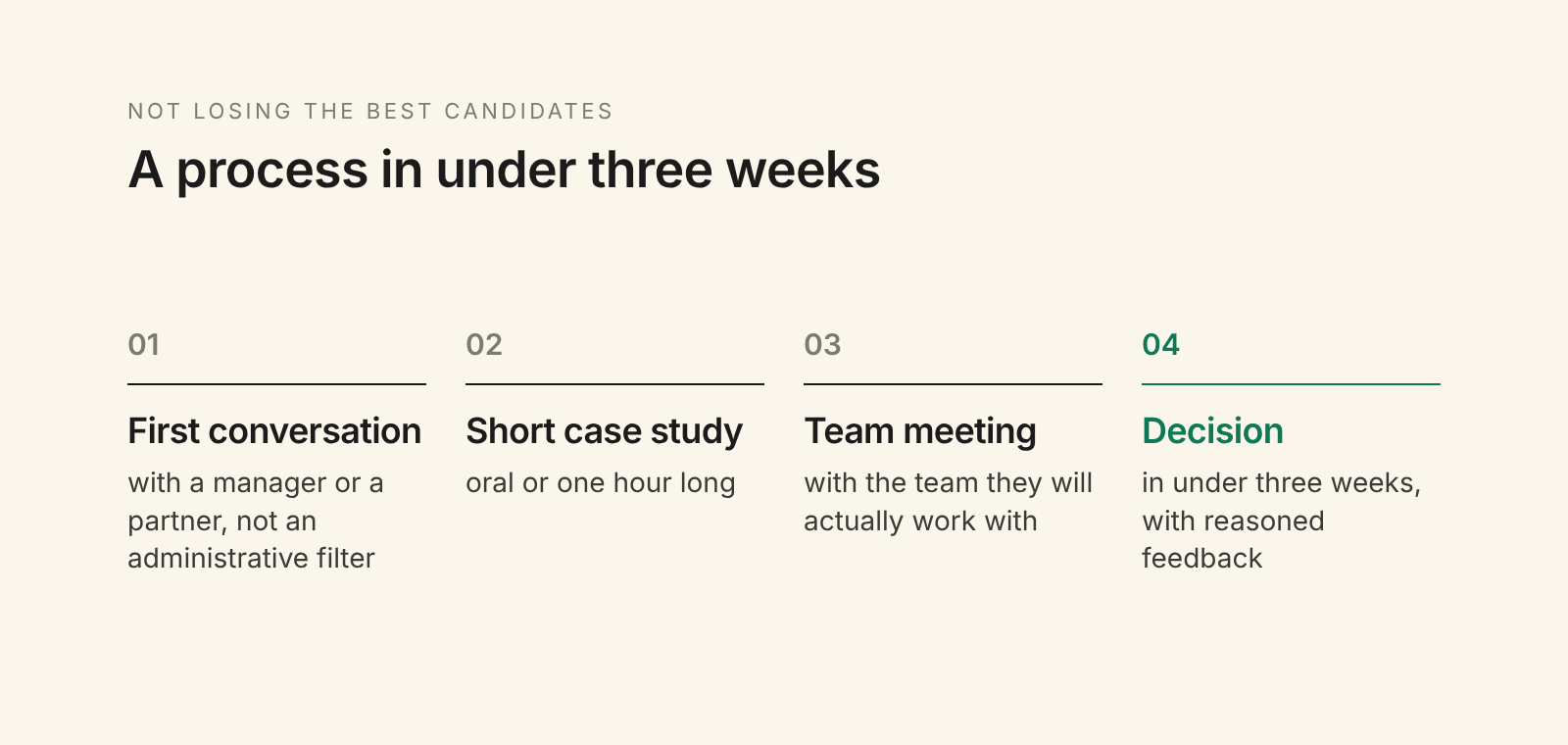
Experienced consultants are approached by several employers at once. A long process sends them elsewhere. The method that works:
- A first conversation with a manager or a partner, not an administrative filter: the candidate wants to talk shop from the first call.
- A short case study, oral or one hour long, never a multi-day assignment to hand in while on a client project.
- A meeting with the team they will actually work with.
- A decision in under three weeks, with reasoned feedback, positive or not.
This process requires partners to set time aside. That is the real hidden cost of direct hiring: three or four slots a week during hiring periods. In return, the candidate meets the people they will work with straight away, and that is often what wins them over against a better-paid competing offer.
Think also of former consultants of the firm, who left for a client or elsewhere. Some would happily come back as managers, and they already know your methods. Keeping them in the pool, with their leaving date and current role, costs little and often pays off.
How do you assess an experienced consultant on facts?
- Recent assignments, the exact role held and the size of the teams managed.
- The ability to structure a problem, tested on a short case rather than claimed.
- Client relationships: a difficult situation, told with what they did and what they would do differently.
- The fit between their career expectations and what the firm can really offer.
Upstream, an application form asking these questions lets you sort before the first call. Seeqle’s qualification agent scores each application on these criteria: partners read the strongest files first, and at Seeqle’s clients, 53% of applications arrive qualified.
Which indicators should you track to steer direct hiring?
- the cost per direct hire, compared with hires made through headhunters;
- the share of currently employed candidates among qualified candidates;
- the time between first conversation and offer;
- the acceptance rate, and the reasons for refusal: pay, assignments, pace.
Tracked quarter after quarter, these figures quickly show whether direct hiring delivers. A falling acceptance rate almost always signals a pay or timing problem, rarely a channel problem. Our article on recruitment KPIs gives the formulas and a tracking template.
Frequently asked questions
Can a mid-sized firm hire without a headhunter?
Yes, for most consultant and manager roles. You need a precise offer, targeted advertising and partners available for the first conversations.
How long should the process take?
Three weeks at most between first conversation and offer. Beyond that, the risk of losing the candidate to another employer rises sharply.
What should you do with good candidates you did not hire?
Keep them in a pool and get back in touch. A consultant who was not ready to move today may well be in six months.
The next step
How do you spend less time sorting applications?
The Match Agent scores every application as it arrives, and you decide.
No credit card. 14 days free.