Where is your hiring losing talent?
7 questions, 2 minutes, 3 action priorities.

Hiring sales associates for a store network is not one hiring project: it is thirty small local hires happening at the same time. What works is a template job offer adapted for each store, advertising set around each address, screening shared across the whole network and a quick decision taken on site by the store manager.
Why is hiring sales associates across a network so difficult?
Because the problem is never the overall volume. A network of forty stores looking for sixty sales associates does not need sixty applications: it needs two or three good candidates in Rennes, one in Brest, four in Nantes, all in the same weeks. A national job offer produces the opposite: plenty of applications where the need is low, almost nothing in the town that is short of staff.
Add a reality of retail: good sales associates already have a job, often in the shop next door, in the same shopping centre. They do not browse job boards. The good news is that employers have broadened their criteria: according to France Travail, in 2025, 74% of recruiters facing difficulties accepted less experienced candidates than planned. The pool is wider than you think, provided you go and find it.
How should work be split between head office and the stores?
Head office brings the method and the advertising, the store brings knowledge of the ground and the decision. When everything goes up to head office, each candidate loses a week. When everything stays in store, each manager improvises their own job offer and nobody steers anything.
| Step | Head office (HR) | Store |
|---|---|---|
| Job offer | Writes the template: duties, benefits, brand tone | Adds address, hours, contract, team size |
| Advertising | Launches and adjusts the campaign, store by store | Flags urgency and number of roles |
| Screening | Sets the questions shared across the network | Receives only applications that answer them |
| Interview and decision | Tracks timelines, chases if things stall | Meets the candidate and decides within 72 hours |
| Talent pool | Keeps good candidates not selected | Calls them back when a role opens nearby |
How do you write a sales associate job offer that makes people want to apply?
An employed sales associate reads a job offer in a few seconds, on their phone, during their break. They want concrete answers, not a list of desired qualities. The network’s template offer must leave room for what only the store knows:
- the exact address and travel time from nearby neighbourhoods;
- the real hours, including Saturdays, late openings and Sunday trading;
- the contract (permanent, fixed-term, part time) and the salary, target bonuses included;
- the team: how many sales associates, who manages, how the first weeks go;
- what makes the brand different: the products, the customers, the opportunities to move up to a manager role.
A job offer without an address or hours is the first cause of useless applications: candidates apply everywhere, then drop out when they discover the commute.
Where do you find sales associates who are not looking for a job?
Where they spend their time: social networks, videos, apps, news sites. 80% of qualified talent is not actively looking, which means a campaign limited to job boards ignores most of the pool. Targeted advertising changes the equation: the job offer is shown to people who work in sales, within a set radius around each store.
The radius is set case by case. In a town centre, a few kilometres are enough, as candidates come on foot or by public transport. In an out-of-town retail park, it has to be wider, since most staff come by car. Our guide to job advertising to reach passive candidates details the formats that work best.
Think about neighbouring sectors too. A sporting goods sales associate knows how to advise a customer on home equipment. A waiter or a receptionist already has a feel for customer contact. Sales know-how transfers better than product knowledge, which can be learnt in a few weeks.

How do you screen without slowing store managers down?
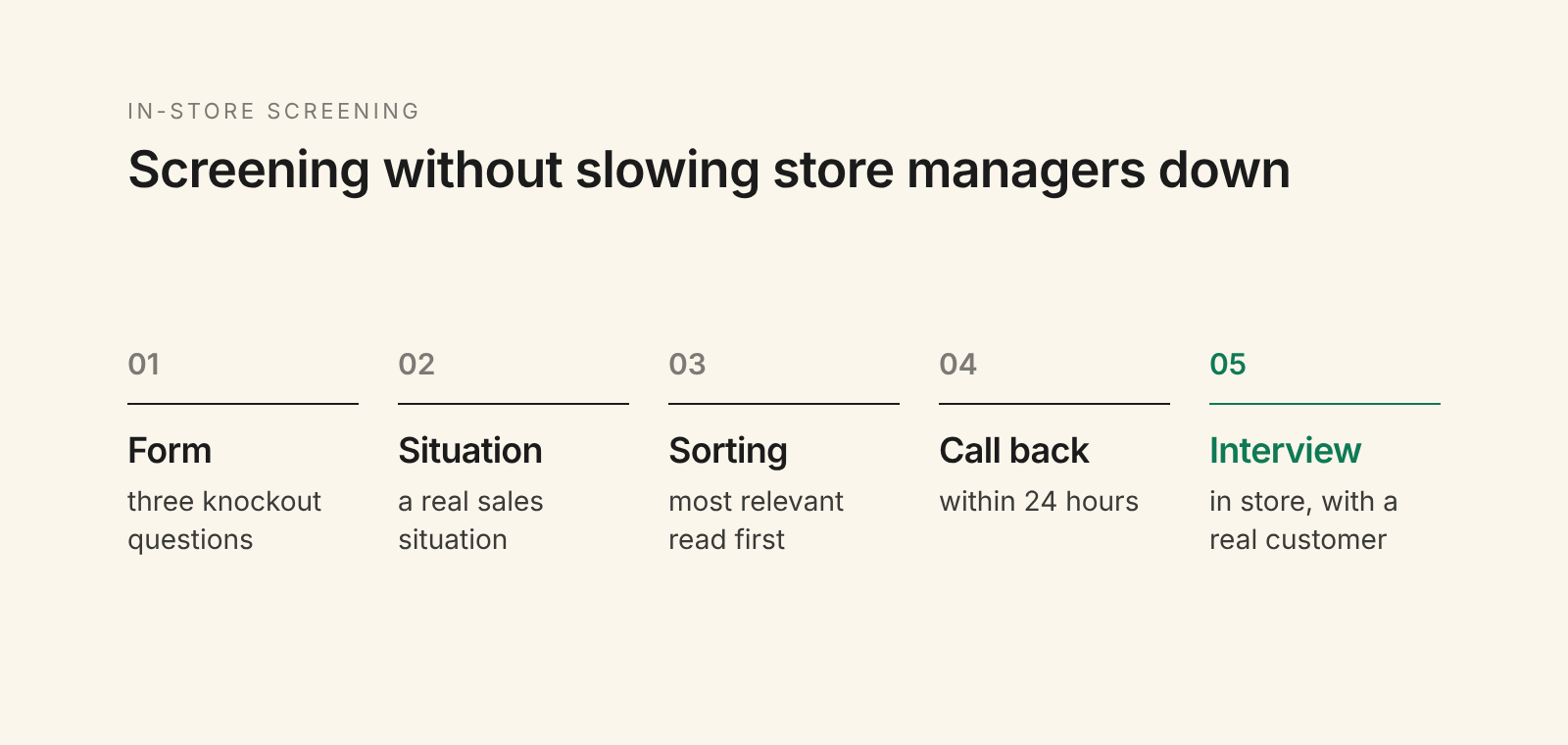
By asking the whole network the same questions, before the interview. The method fits in five steps:
- Three knockout questions in the form: availability on peak slots, contract sought, acceptable travel time.
- One open question about a real sales situation, to judge ease with customers rather than a CV.
- Automatic sorting that ranks applications by these answers, so the manager reads the most relevant first.
- A call back within 24 hours to shortlisted candidates: beyond that, a good sales associate has often accepted another offer.
- An in-store interview, during opening hours, to see the candidate in front of a real customer.
A qualification agent such as Seeqle Match handles steps 1 to 3: each application is scored on the role’s criteria, and the store manager only receives those worth a call.
Which indicators should you track store by store?
A network is steered store by store, not on a national average. Three figures are enough on the dashboard:
- the number of shortlisted applications per store;
- the time between application and in-store interview;
- the number of roles filled, compared with roles open.
A store falling behind stands out at a glance, and advertising can be stepped up in its area alone, without touching the rest of the network. To go further, our article on recruitment KPIs gives the formulas and a dashboard template.
Which mistakes cost a network the most?
- Posting the same national job offer for every store, with no address or hours.
- Having head office approve every candidate and losing a week each time.
- Starting to hire extra staff for the festive season in November, when the whole shopping centre is hiring too.
- Discarding good candidates who were not selected: the one who did not suit Lille may suit Roubaix the following week.
Conversely, a network that advertises in the right place and decides quickly changes scale. For Kia and Honda, who were looking for sales advisers in their dealerships, targeted advertising tripled traffic on job offers and increased relevant applications by 500%, in under two months. The full set-up is in the Kia and Honda case study. Our page on hiring in retail presents store-by-store steering, and the Seeqle diagnostic measures in a few minutes where your network loses candidates.
Frequently asked questions
How do you hire sales associates for several stores at once?
With a template job offer adapted for each store, targeted advertising around each address and shared screening, then an interview and decision in store.
Should you require sales experience?
Not necessarily. Experience in hospitality, reception or events often prepares people very well for customer contact. The product can be learnt; ease with customers much less so.
How much time should you allow to hire before the festive season?
Allow two months before the peak: one month to advertise and screen, one month for interviews, contracts and on-the-job training.
The next step
How do you spend less time sorting applications?
The Match Agent scores every application as it arrives, and you decide.
No credit card. 14 days free.