Where is your hiring losing talent?
7 questions, 2 minutes, 3 action priorities.

In healthcare as in IT, the most sought-after candidates no longer apply: they have a job and do not read job offers. To hire them, you have to reverse the logic and show the job offer where they already spend their time, with precise targeting by profession and by area. That is what programmatic recruitment does, bringing job boards and targeted advertising together in one campaign and one budget.
Why are job boards no longer enough in healthcare and IT?
A job board only reaches candidates who are actively looking. In these two markets, they are a minority: 80% of qualified talent is not actively looking for a role. Posting a job offer and waiting means speaking to only a fraction of possible candidates, often the same ones every other employer sees.
Both sectors show the same symptom for different reasons. In healthcare, carers work back-to-back rotas and have neither the time nor the habit of browsing job offers; when they change jobs, it is often through word of mouth. In IT, experienced developers are over-solicited and ignore most messages that look like a generic offer. In both cases, the problem is not a lack of candidates, it is that traditional channels cannot see them.
There is a less visible side effect. When every employer in an area posts on the same sites, they all compete for the same active candidates. Offers look alike, salaries rise, and the candidate ends up choosing whoever called back first. Going after passive candidates takes you out of that head-on competition.
What does programmatic recruitment change for these two sectors?
The principle comes from digital advertising: the job offer is distributed automatically, as a visual ad, on the sites, apps, videos and podcasts the target audience already uses. The algorithm keeps shifting placements and budget toward what produces qualified applications.
Seeqle relies on more than 400,000 targeting criteria and more than 5,100 job profiles, across 2M+ sites and apps and 35+ job channels including Indeed. A nurse reading local news or a developer watching a technical video sees the offer at a moment when they have time to read it. Our guide to job advertising for passive candidates details the formats that convert.
Healthcare and IT: how does targeting differ?
The mechanics are the same, the settings are not. A campaign copied from one sector to the other loses much of its effectiveness.
| Setting | Healthcare | IT |
|---|---|---|
| Area | Tight around the facility: carers work on site and on shifts | Wider, even national if remote work is possible |
| Targeting | Profession (nurse, care assistant, lab technician), specialism, ward | Skill, technology used, seniority |
| Message | Rota, team, patient ratio, support when starting the job | Tech stack, autonomy, projects, remote work |
| Timing | Outside shift hours, in the evening and at weekends | During the day and in the evening, on technical content |
| Qualification | State diploma and licence to practise to check from the start | Skills to check through a technical conversation |
How do you reach carers who are not looking?
An employed carer will not read a three-paragraph offer about the facility's values. They look at what concretely changes for them. Campaigns that work in healthcare have this in common:
- a realistic area, based on commuting time rather than on administrative boundaries;
- the rota stated clearly in the offer: rotation, weekends, nights;
- a real photo of the ward rather than a generic hospital picture;
- a short form that does not ask for a full CV at first contact;
- a fast call back: a carer who clicked between two shifts cools down within days.
Also think of the professions close to care, often forgotten in targeting: lab technicians, radiographers, hospital pharmacy technicians. They are just as rare and even less solicited.

How do you attract tech profiles who already have a job?
An employed developer or data engineer already receives approaches. What makes the difference is precision. An offer that states the stack, the type of project and the way of working in its first lines stands out from generic messages. On the targeting side, the campaign is set by skill or technology rather than by job title: a “back-end developer” and a “software engineer” can do exactly the same job.
The first message matters as much as the targeting. A tech candidate who clicks wants to know quickly whether they are wasting their time: which product, which team, how much technical debt, how often releases ship. A landing page that answers these questions without forcing them to send a full CV converts far better than a generic form.
- Name the technologies you really use, without a list of filler acronyms.
- Give the salary range and the remote work policy.
- Show a real technical topic from the team rather than a slogan.
- Plan a first conversation with an engineer, not only with HR.
How do you launch a campaign in five steps?
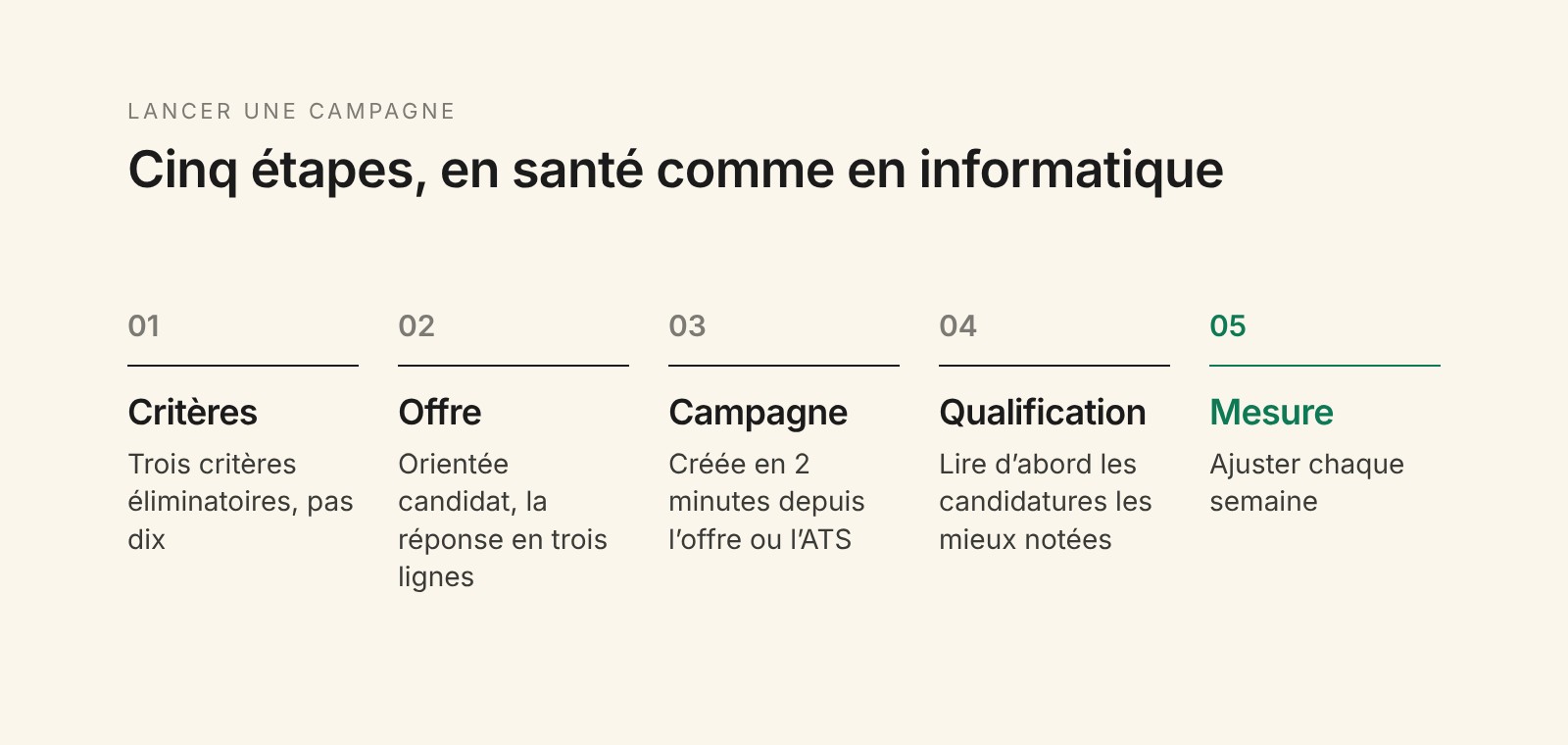
- Set three knockout criteria: diploma or licence to practise in healthcare, key skill in IT, area or way of working.
- Write a candidate-focused job offer that answers, in three lines, the question “what changes for me?”.
- Create the campaign: with Seeqle’s Attract Agent, it takes 2 minutes from the job offer or from your ATS.
- Qualify applications as they arrive, reading the best-scored ones first: on average, 53% of the applications received on Seeqle campaigns are qualified.
- Measure and adjust every week: qualified applications, time to first contact, interview attendance rate.
How much does a campaign cost, and how does it connect to your ATS?
The budget depends on the number of roles and on how tight the target market is, which is higher in healthcare and IT than for most professions. Seeqle is available from €500 per month, with a 14-day free trial and no credit card. To compare this budget with the real cost of a role that stays vacant, our page on the cost of a hire in France details the calculation method.
A healthcare facility or a tech team almost always has an ATS or an HRIS. Seeqle connects to 60+ ATS and CRM: job offers leave from the ATS, and analysed applications come back to it. The criteria to check before choosing are covered in our guide to choosing a candidate acquisition platform. To take stock of your situation, the Seeqle diagnostic takes a few minutes.
Frequently asked questions
Does programmatic recruitment replace job boards?
No, it includes them: job boards reach candidates who are looking, programmatic distribution reaches those who are not, all in one campaign and one budget.
Can you target a precise specialism, such as theatre nurses?
Yes. Targeting combines profession, specialism and area, and the job offer should name that specialism in its title.
How long before the first applications?
Distribution starts once the campaign is approved. The first days also let the algorithm identify the placements that work best.
The next step
How do you spend less time sorting applications?
The Match Agent scores every application as it arrives, and you decide.
No credit card. 14 days free.